

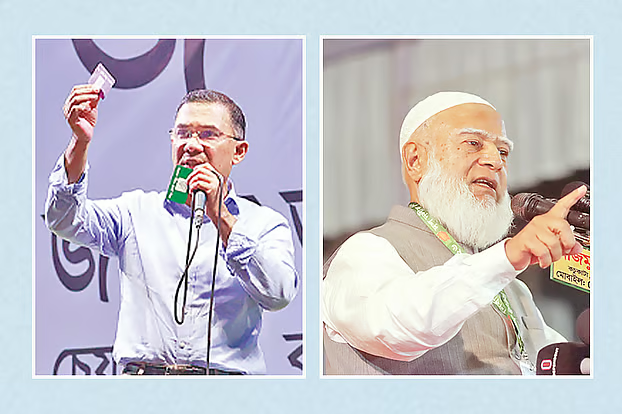
After nearly 17 years, the country is heading towards a competitive national election. This electoral journey began in a calm atmosphere on Thursday, 22 January.
In the absence of the ousted Awami League, the Bangladesh Nationalist Party (BNP) and the Jamaat-e-Islami–led 10-party electoral alliance have emerged as the principal rival forces in this election.
However, from the very first day of campaigning, the two main contenders, BNP and Jamaat-e-Islami, have begun exchanging aggressive statements on several specific issues.
Only two days have passed since the start of the election campaign. An analysis of the statements made by senior leaders of BNP and Jamaat over Thursday and Friday clearly indicates that the intensity of mutual attacks is likely to increase in the coming days.
Following the mass uprising of 5 August 2024, the changed political context had already suggested that BNP and Jamaat would adopt increasingly opposing positions around the national election.
Current developments indicate that the situation is moving in that direction.
Notably, BNP has raised allegations against Jamaat concerning the party’s role during the 1971 Liberation War, the misuse of religion to mislead the public and alleged conspiracies involving “election engineering”.
From the very first day of campaigning, the two main contenders, BNP and Jamaat-e-Islami, have begun exchanging aggressive statements on several specific issues.
Counterattacks
Over the past two days, BNP chairperson Tarique Rahman addressed eight public rallies across Dhaka (including Bhashantek), Sylhet, Moulvibazar, Habiganj, Brahmanbaria, Kishoreganj, Bhairab, Narsingdi and Araihazar in Narayanganj.
Meanwhile, Jamaat-e-Islami Ameer Shafiqur Rahman spoke at five public meetings in Mirpur, Dhaka, and in the northern districts of Panchagarh, Thakurgaon, Dinajpur and Rangpur.
A comparative analysis of their speeches reveals clearly opposing positions.
Without naming Jamaat explicitly, Tarique Rahman criticised its role as an anti-independence force in 1971 and described promises of “tickets to heaven” made in the name of religion as shirk and kufr.
Without naming Jamaat explicitly, Tarique Rahman criticised its role as an anti-independence force in 1971 and described promises of “tickets to heaven” made in the name of religion as shirk and kufr.
He alleged that rival parties claim to advocate honest governance while engaging in dishonest practices themselves and deceiving people by exploiting religious sentiment.
He repeatedly warned of conspiracies to rig the election, including the snatching of postal ballots and vote manipulation through the collection of National Identity (NID) details and mobile phone numbers.
On Friday, this verbal confrontation took on a new dimension. At an election rally in Khulna, Jamaat secretary general Mia Golam Parwar described the election as a “constitutional jihad to establish Islamic values”.
He stated, “Wars were once fought with swords, bows and cannons. Now the battle is fought through the ballot.” Strongly criticising Tarique Rahman’s remarks, Golam Parwar said, “No Muslim can declare another Muslim a kafir… he has committed a grave offence.”
The solution for the country is for the election to take place and for it to be conducted peacefully and in a normal manner. Political debate and mutual criticism will exist, what matters is that they do not cross acceptable limits.
Professor Mahbub Ullah, political analyst
He further remarked, “He has now become a great mufti… issuing fatwas from abroad about who is Muslim and who is not.”
Conversely, Jamaat has accused BNP of past corruption, land grabbing and extortion by its leaders and activists, both historically and in recent times, and of evolving into what it describes as a form of “neo-fascism”.
A particularly notable issue raised by both sides is that of “foreign domination”. BNP accuses Jamaat of allegiance to Pindi, a reference to Pakistan, while Jamaat accuses BNP of submitting to Delhi’s hegemony.
Taken together, alongside electoral rivalry, a new and direct confrontation has clearly emerged in the political arena. The verbal battle now centres on several key issues: the Liberation War, foreign influence, the use of religion, corruption, extortion, and allegations of “neo-fascism”.
Political analyst and University of Dhaka professor Mahbub Ullah described this as a matter of “political or ideological positioning”. Speaking to Prothom Alo, he said that in order to demonstrate their differences, parties inevitably raise such issues.
However, he warned that the real concern is whether these disputes could escalate into major conflict. As long as that does not happen, he suggested, the situation should be viewed as normal.
Professor Mahbub Ullah further stated, “The solution for the country is for the election to take place and for it to be conducted peacefully and in a normal manner. Political debate and mutual criticism will exist, what matters is that they do not cross acceptable limits.”
Beginning in Sylhet on Thursday and continuing through rallies in seven districts including Habiganj, BNP chairperson Tarique Rahman directly targeted Jamaat and its allies, declaring: “Not Delhi, not Pindi, nor any other country, Bangladesh comes first.”
He added that while some flee to Delhi and others to Pindi, BNP stands with the people of Bangladesh.
At the beginning of each of his speeches, Tarique Rahman strongly criticised the ousted Awami League for 15 years of enforced disappearances, killings, torture, the deprivation of voting rights and the laundering of national wealth abroad.
While this criticism was intense, he did not dwell on it for long. Instead, he quickly shifted focus to BNP’s future plans and what he described as current conspiracies by rival forces ahead of the election.
In his seven public rallies, Tarique Rahman addressed not only national political issues but also the specific local problems of each district.
In his speeches, Tarique Rahman made specific commitments related to development, including the introduction of a “family card”, a “farmer card”, canal excavation projects, and skills training for the unemployed. At every rally, he sought the direct support of the attending public.
One particularly notable feature of Tarique Rahman’s election rallies over the past two days has been his spontaneous, direct interactions from the stage with people from different professions and social groups. This was especially striking at the Bhashantek rally yesterday, Friday.
